Guns scare the shit out of me. I've never shot one or even touched one (had the opportunity to in Alabama one summer with friends, but declined (I think they thought I was being ideological)). If it was my decision to make, I would destroy all guns. Invariably when I leave movies like "Stop-Loss," I will make this comment to friends: That movie was lame, but the way they portray the danger of guns is amazing. Blood Diamond comes to mind. In keeping with earlier posts, I missed this film in theaters, so I watched a pretty terrible bootleg copy online, at like three in the morning. "Stop-Loss" is basically a melodrama, so formulaic that you can predict each new scene down to the smallest of details, but there are several scenes where guns play a central role, and they all freaked me out.
Go here and click on the fifth video. It's the one with a dude with a buzz cut and no shirt holding a big rifle. It's intense, even at this resolution.
I found the ending of the film kind of frustrating.
Spoiler alert.
I guess I think it sucks that he just goes back to the army. I think it's realistic, and it doesn't necessarily cheapen the earlier drama. But it still kind of sucks. To me it presents a quite nihilistic view of human nature. Ryan Phillippe's character, Sgt. King, goes back to Iraq because he realizes he can't start his life over. He's obviously not against war as a concept, his flight is motivated by self-preservation, and the feeling that he's being treated unfairly. He goes back because he would rather risk his life than try to live it without his family, his hometown, and his country. I sympathize with the decision (who knows what I would do in his situation), but can't help thinking that the film-maker, Kimberly Pierce presents a depressing view of people (articulate, eh?).
Though I didn't care for the narrative of the film, I found the cinematography good and thought the acting was compelling (I don't really know anything about acting, but still). But it is most successful in it's unbiased use of an incredibly contentious political topic to produce a thought provoking narrative experience. The viewer is forced to wonder what they would do in Sgt. King's situation, a degree of empathy not often required by film.
I could also talk a lot about the representation of masculinity in this film, but I think I'll save it. I still need to download "Redacted" and "In the Valley of Elah."
16 May 2008


05 May 2008
Youtube
This video was sent a few days ago by a friend:
It's pretty funny, though gets kind of boring. The payoff is definitely not worth the buildup. But it is successful in its attention to detail, like the fake URL at the end, and the way it imitates the the grammatical constructions of "real" 9/11 conspiracy videos. I'm not sure if this is intended, but I think it is accurate in its mocking of making vague claims that aren't actually corroborated by the video--I'm never really sure what it is I'm supposed to be looking at in videos like this one:
(Interesting detail: the URL in this vid is also broken).
Like other, longer format documentaries, I am forced to question the motive behind these kinds of videos, the "real" ones at any rate. Real meaning they aren't jokes, like the first video. This video is so annoying to watch, with its glitch-y editing, it seems more like a stylized video art project than anything else.
The juxtaposition of these videos seems to capture the dichotomy of responses to the art of conspiracy theory. I find that most people are either quick to believe conspiracies, if not all, then some, while others are even quicker to make some sort of "mature" analysis like this one which was added by the editor to my brooklyn rail article: "Like all conspiracy theories, it taps into the powerlessness felt by the masses." I guess if I really had to think about it, I would probably be on the side of the editor, but I like to at least entertain the possibility of conspiracies before asserting my intellectual superiority over those who invent them. If nothing else, the creators of conspiracy theories, at least decent ones, are magnificent story tellers and fabricators, worthy of that much more praise for convincing at least the gullible among us that what they say is real. Much better than this guy anyway.
It's pretty funny, though gets kind of boring. The payoff is definitely not worth the buildup. But it is successful in its attention to detail, like the fake URL at the end, and the way it imitates the the grammatical constructions of "real" 9/11 conspiracy videos. I'm not sure if this is intended, but I think it is accurate in its mocking of making vague claims that aren't actually corroborated by the video--I'm never really sure what it is I'm supposed to be looking at in videos like this one:
(Interesting detail: the URL in this vid is also broken).
Like other, longer format documentaries, I am forced to question the motive behind these kinds of videos, the "real" ones at any rate. Real meaning they aren't jokes, like the first video. This video is so annoying to watch, with its glitch-y editing, it seems more like a stylized video art project than anything else.
The juxtaposition of these videos seems to capture the dichotomy of responses to the art of conspiracy theory. I find that most people are either quick to believe conspiracies, if not all, then some, while others are even quicker to make some sort of "mature" analysis like this one which was added by the editor to my brooklyn rail article: "Like all conspiracy theories, it taps into the powerlessness felt by the masses." I guess if I really had to think about it, I would probably be on the side of the editor, but I like to at least entertain the possibility of conspiracies before asserting my intellectual superiority over those who invent them. If nothing else, the creators of conspiracy theories, at least decent ones, are magnificent story tellers and fabricators, worthy of that much more praise for convincing at least the gullible among us that what they say is real. Much better than this guy anyway.
22 April 2008
Guerilla journalism
I finally finished reading Shooting War, a really disgusting comic book--nay graphic novel, this book truly deserves the lofty graphic novel distincing--after putting if off for a long time. When it first came out I had no intention of reading it, and then I started this blog, and it seemed like an interesting piece to use. It was painful to get through. Anthony Lappe's writing is cliche, annoying and at time just plain boring, while Dan Goldman's art is actually hard to look at, and so trenderized it's depressing. A representative panel of both collaborator's shortcomings:
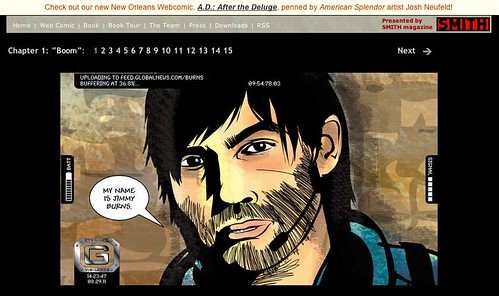
Shooting War is set in 2011, when John McCain is president and the war in Iraq has continued with no success or end in sight. The protagonist is Jimmy Burns, a renegade video blogger who has gained a name for shocking stories and footage. His catch phrase: "I have a knack for being in the right place when people are going to die." That line is worthy of Hombre or Fistful of Dollars, but I can only wish that it is meant to be read with at least some degree of irony. The plot of the book is pretty similar, if greatly lacking in originality, cohesiveness and continuity, of those seen in books coming out of the big houses, Marvel and DC, and imitates the edgy style of DC's Vertigo imprint (I am all too familiar with these plots after doing a soul crushing stint in the Marvel editorial department). Perhaps its difficulties with continuity in plot are due to its origination as a serialized web comic, but this does not forgive the confusing and lazy way a relatively straight forward plot is related. Time seems to progress forward randomly. The characters and dialog are extremely flat. I guess I've already told you that this is a bad book.
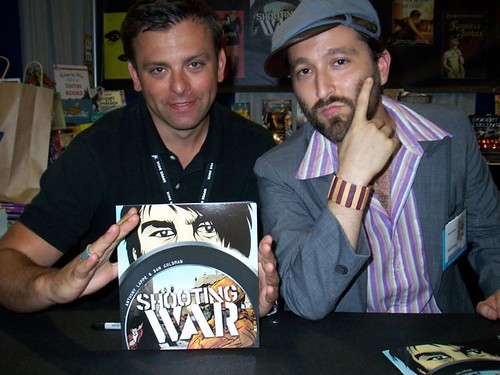
Apparently Lappe is the executive editor for the Guerrilla News Network's website, which I visited occasionally in high school, but found boring even then. Lappe is a little like Aliza Shvarts, who I discussed last post, in that he is clearly interested in being edgy, but seems unsure of how to do it. The politics of Shooting War aren't exactly ambiguous, but they are certainly incomplete and a bit over the top. In the conclusion, President McCain is so moved by the footage broadcast by Jimmy Burns of Iraqis being tortured that he decides to withdraw American soldiers. It seems like a joke, but the book doesn't end any other way. The combination of trendy liberal politics, trendy graphic art and absurd masculine fantasy, all of which seem incomplete in their conception, makes this work seem like even more of a get noticed quick scheme than Zeitgeist. What is sad is that the creators actually seem earnest in their efforts. But what can you expect from a couple of guys that look like this:
I'm not going to waste my time writing a pseudo academic essay like I have in previous posts, but I'll take a stab at analyzing Shooting War's use of politically relevant material as a device for plot and style after the jump.
Shooting War is set in 2011, when John McCain is president and the war in Iraq has continued with no success or end in sight. The protagonist is Jimmy Burns, a renegade video blogger who has gained a name for shocking stories and footage. His catch phrase: "I have a knack for being in the right place when people are going to die." That line is worthy of Hombre or Fistful of Dollars, but I can only wish that it is meant to be read with at least some degree of irony. The plot of the book is pretty similar, if greatly lacking in originality, cohesiveness and continuity, of those seen in books coming out of the big houses, Marvel and DC, and imitates the edgy style of DC's Vertigo imprint (I am all too familiar with these plots after doing a soul crushing stint in the Marvel editorial department). Perhaps its difficulties with continuity in plot are due to its origination as a serialized web comic, but this does not forgive the confusing and lazy way a relatively straight forward plot is related. Time seems to progress forward randomly. The characters and dialog are extremely flat. I guess I've already told you that this is a bad book.
Apparently Lappe is the executive editor for the Guerrilla News Network's website, which I visited occasionally in high school, but found boring even then. Lappe is a little like Aliza Shvarts, who I discussed last post, in that he is clearly interested in being edgy, but seems unsure of how to do it. The politics of Shooting War aren't exactly ambiguous, but they are certainly incomplete and a bit over the top. In the conclusion, President McCain is so moved by the footage broadcast by Jimmy Burns of Iraqis being tortured that he decides to withdraw American soldiers. It seems like a joke, but the book doesn't end any other way. The combination of trendy liberal politics, trendy graphic art and absurd masculine fantasy, all of which seem incomplete in their conception, makes this work seem like even more of a get noticed quick scheme than Zeitgeist. What is sad is that the creators actually seem earnest in their efforts. But what can you expect from a couple of guys that look like this:
Avant Garde
I found that this jezebel post, which Elena sent to me last week, while not directly related to the content of this blog, certainly provides a good example of an artist who has used a political message to gain exposure. I won't waste my time explaining the silliness of this "work of art", which involves the supposed remains of several self-induced miscarriages by a Yale University senior, as jezebel has done the job well. What I find interesting is that after Yale released a statement denying the veracity of substance of the miscarriages displayed, the artist, Aliza Shvarts, responded to claim that Yale was wrong. Is it really important for her work, the goal of which she claims is to start a dialog about real issues through art--which apparently doesn't happen--contain the actual blood and tissue of her supposed miscarriages?
It seems to me that if the tissue is real, then her work is not really art, because it is not representational, it is an artifact. Obviously many hot-headed undergraduates would disagree with this definition of "art", and I have no intention of bringing this blog into the distorted realm of that debate, but it's relevant given the question that my blog poses. What about using fake blood, or paint, or some substance other than her own miscarried pregnancy, denies her work it's message? It seems more likely, that while making a painting of a miscarriage is certainly interesting, it has nowhere near the shock value, or potential media interest, as some chick who actually did this to herself. Shvarts claims that her piece is meant to spark public dialog, but it's unclear what she wants that dialog to be about.
One conclusion that can be drawn from this event, which is sort of depressing, is that the modern art world is influenced by shock value. While there are tons of artists creating truly innovative, provocative and impressive works, often it is the more shocking works--see "Piss Christ"--that receive public attention outside of the art world, and thus make a name for those artists, obviously regardless of the real merit of the work. That sucks.
It seems to me that if the tissue is real, then her work is not really art, because it is not representational, it is an artifact. Obviously many hot-headed undergraduates would disagree with this definition of "art", and I have no intention of bringing this blog into the distorted realm of that debate, but it's relevant given the question that my blog poses. What about using fake blood, or paint, or some substance other than her own miscarried pregnancy, denies her work it's message? It seems more likely, that while making a painting of a miscarriage is certainly interesting, it has nowhere near the shock value, or potential media interest, as some chick who actually did this to herself. Shvarts claims that her piece is meant to spark public dialog, but it's unclear what she wants that dialog to be about.
One conclusion that can be drawn from this event, which is sort of depressing, is that the modern art world is influenced by shock value. While there are tons of artists creating truly innovative, provocative and impressive works, often it is the more shocking works--see "Piss Christ"--that receive public attention outside of the art world, and thus make a name for those artists, obviously regardless of the real merit of the work. That sucks.
Subscribe to:
Comments (Atom)